🔒 Need Industrial Rope Netting That Meets OSHA & EN Standards?
Get certified stainless steel rope netting engineered for your load, environment, and compliance needs.
Request a Quote →Key Takeaways
- Material matters: 304 stainless for general use; 316 marine‑grade for high‑chloride environments.
- Construction type impacts performance: Knotted mesh offers plain‑weave strength; ferrule‑type (knotless) provides cleaner aesthetics with equal physical properties.
- Compliance is non‑negotiable: OSHA 1926.105 (US) and EN 1263‑1 (Europe) set the safety standards your netting must meet.
- Low maintenance = lower total cost: Stainless steel rope netting resists UV, moisture, and extreme temperatures, requiring minimal upkeep.
- Customization is standard: Wire diameter (1.0–6.0 mm) and mesh opening (20–300 mm) can be tailored to your load and safety requirements.
Executive Summary (The Snippet Killer): Industrial rope netting is a high‑strength, flexible safety and barrier solution for construction, cargo securement, marine, and architectural projects. Stainless steel wire rope netting delivers tensile strength up to 2,000 MPa, corrosion resistance, and decades of service life—outperforming synthetic alternatives. This guide covers material selection, OSHA & EN standards, load capacity, and procurement best practices for US and European purchasers.
What Is Industrial Rope Netting?
Industrial rope netting is an engineered grid‑like structure made from interconnected ropes—typically stainless steel wire rope—designed to provide high‑strength barriers, fall protection, and load restraint across demanding industrial environments.
Definition and Core Characteristics
Unlike standard fencing or synthetic nets, industrial rope netting combines exceptional tensile strength (1,500–2,000 MPa) with flexibility and visual permeability. The 7×7 or 7×19 strand configurations ensure high impact resistance while maintaining structural integrity.
Key Industries and Sectors
- Construction – scaffolding safety nets and perimeter fall protection
- Marine & Offshore – helideck safety nets, cargo securement, shipyard protection
- Architecture – building facades, green walls, balustrade infill
- Logistics – cargo restraint and load securement systems
- Mining & Geotechnical – rockfall protection and barrier systems
For architectural applications, explore our architectural cable mesh solutions designed for modern building facades and interior design.
Industrial Rope Netting Materials: A Comparative Analysis
Stainless steel wire rope mesh (304/304L/316/316L) is the premium choice—resisting rust, UV, and extreme conditions with virtually zero maintenance.
Our stainless steel cable net is made from 304/316 stainless steel rope, guaranteeing no corrosion after decades outdoors.
Construction Types: Knotted vs. Ferrule (Knotless)
Knotted Rope Netting
Uses a plain weave where each warp wire rope crosses alternately above and below each weft wire rope. Provides excellent strength for zoo enclosures, safety barriers, and heavy‑duty industrial applications.
Ferrule (Knotless) Rope Netting
Combines wire ropes using stainless steel ferrules (clamps) instead of knots. Delivers the same physical properties with a smoother, more aesthetic surface—ideal for architectural facades and balustrades.
Hand‑Woven and Specialty
For premium architectural and marine projects, hand‑woven stainless steel rope mesh offers unlimited width/length with rhombic patterns (typically 60° angles), optimizing both strength and flexibility.
Industrial Applications Across Sectors
- Construction & Scaffolding Safety Nets – guard rails and perimeter fall protection.
- Cargo Securement & Load Restraint – stainless cargo nets with anti‑corrosion and UV resistance.
- Marine, Coastal & Offshore – helideck safety nets, shipyards (316 grade).
- Architectural & Façade Netting – decorative installations, green walls, vertical gardens.
- Rockfall Protection & Geotechnical – permanent barriers against debris, outperforming plastic nets.
Industrial Rope Netting vs. Chain Link Fencing
Regulatory Standards and Compliance
Procurement Tip: Always request certification documentation (SGS, BV, CE) from your supplier.
How to Select the Right Industrial Rope Netting
Assessing Load Requirements and Impact Resistance
Determine maximum load. For fall protection, ensure the netting meets OSHA's 17,500 ft‑lb impact resistance.
Evaluating Environmental Conditions
- Indoor / General: 304 Stainless Steel
- Outdoor / Urban: 304 Stainless Steel
- Coastal / Marine: 316 Stainless Steel
- Chemical / High‑Chloride: 316L Stainless Steel
Determining Mesh Size and Rope Diameter
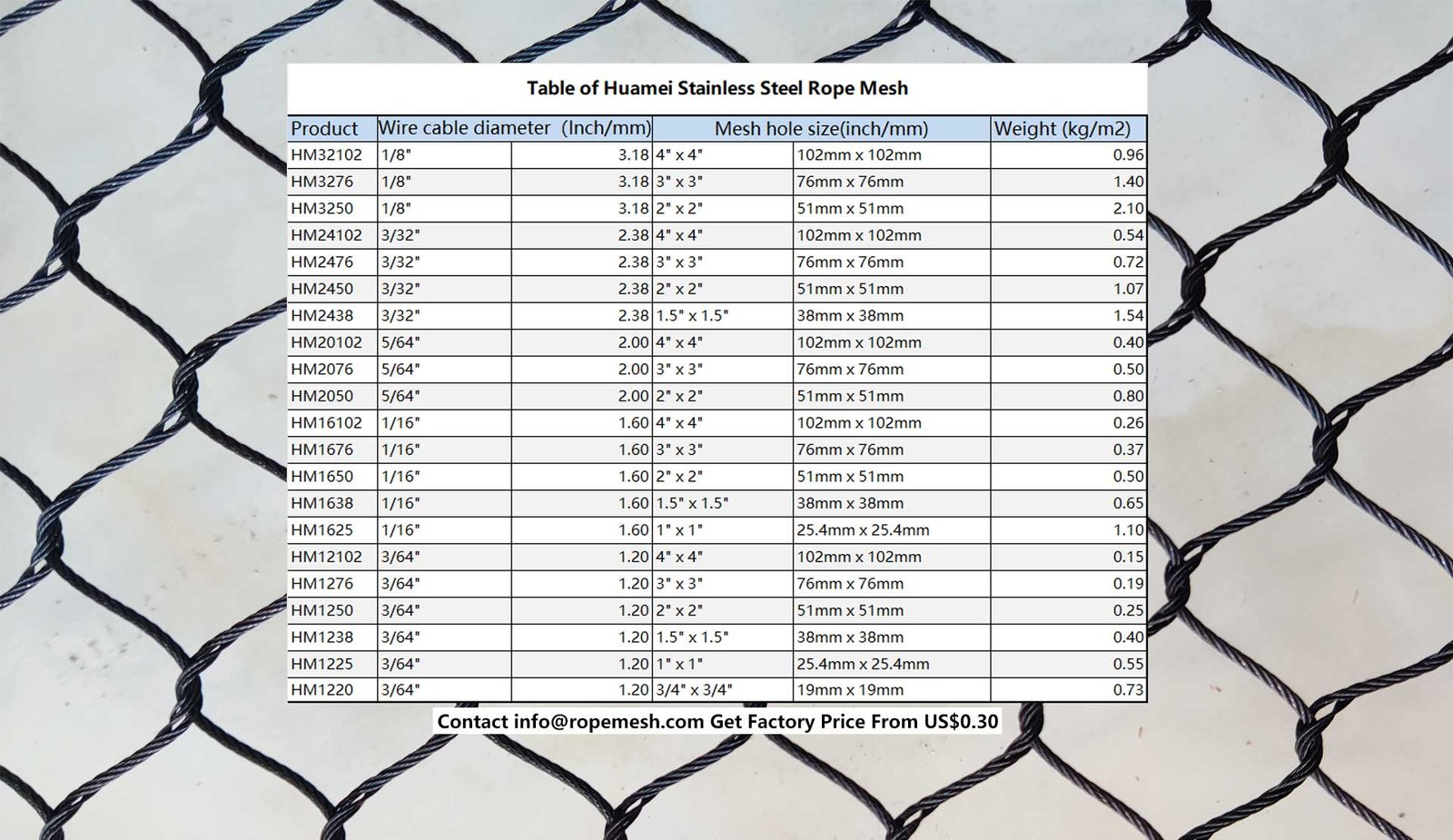
Wire diameters range from 1.0 mm to 6.0 mm; mesh openings from 20 mm × 35 mm to 200 mm × 346 mm. Smaller openings and thicker wires increase load capacity.
Certification and Testing
Always verify independent test certifications (SGS, BV, CE) and request breaking strength test reports.
Installation and Maintenance Best Practices
Installation
- Site Assessment: Measure area, identify anchor points.
- Anchoring: Use stainless steel fittings matching the netting grade.
- Tensioning: Apply even tension across the entire mesh surface.
- Safety: Follow all OSHA/EN fall protection protocols.
Maintenance and Inspection
- Visual inspection — before each use
- Detailed structural inspection — annually (logged)
- Cleaning — mild detergent, rinse, dry (as needed)
- Corrosion check (marine) — quarterly
Stainless steel nets require virtually no maintenance in most environments.
Sourcing and Procurement Strategy
Evaluating Supplier Capabilities
Look for manufacturers with 20+ years of experience, in‑house engineering, CE/ROHS certifications, and export experience to US/European markets.
Custom vs. Standard
Most industrial applications require custom specifications—wire diameter, mesh opening, dimensions, edge treatments. Suppliers like BMP offer OEM/ODM services with quick lead times.
Lead Times and Logistics
Production lead times typically range from 2–6 weeks for custom orders. Plan procurement accordingly.
Frequently Asked Questions
What is the difference between industrial rope netting and chain link fencing?
Industrial rope netting offers superior tensile strength (1,500–2,000 MPa), flexibility, and impact absorption compared to rigid chain link. Unlike chain link, which corrodes and creates a "prison look," rope netting maintains aesthetic transparency while providing high‑strength barrier protection. Stainless steel rope netting also has a higher strength‑to‑weight ratio and requires minimal maintenance.
What are OSHA requirements for industrial rope safety nets?
OSHA Standard 1926.105 requires mesh size ≤6"×6", minimum impact resistance of 17,500 ft‑lb, and a proof test certification label. Perimeter edge ropes must meet specified minimum breaking strength.
How do I choose the right rope material for industrial netting?
Selection depends on application: 304 Stainless Steel for general industrial/architectural; 316 for marine/coastal/high‑chloride; Nylon for high impact absorption; Polyester for dimensional stability. For demanding environments, stainless steel is recommended for durability and long service life.
How often should industrial rope netting be inspected and maintained?
Inspect before and after each use; conduct a thorough annual inspection by a competent individual. Stainless steel nets require virtually no maintenance; synthetic nets need cleaning with mild detergent, rinsing, and complete drying before storage.
What is the load capacity of industrial rope netting?
Load capacity varies with material, rope diameter, mesh size, and construction. High‑quality stainless steel wire rope netting features breaking strengths of 1,500–2,000 MPa. Always consult product‑specific load tables and certifications from manufacturers.
📋 Ready to specify industrial rope netting?
Download our free specification checklist — includes material selection guide, compliance requirements, and load calculation worksheet.
Browse Full Products →🔗 Related Applications
Zoo Enclosures | Aviary Mesh & Bird Netting | Wildlife & Deer Fencing | Exotic Bird & Peacock Cages | Agricultural & Farm Fencing | Architectural Cable Mesh
📖 Related Articles & Projects